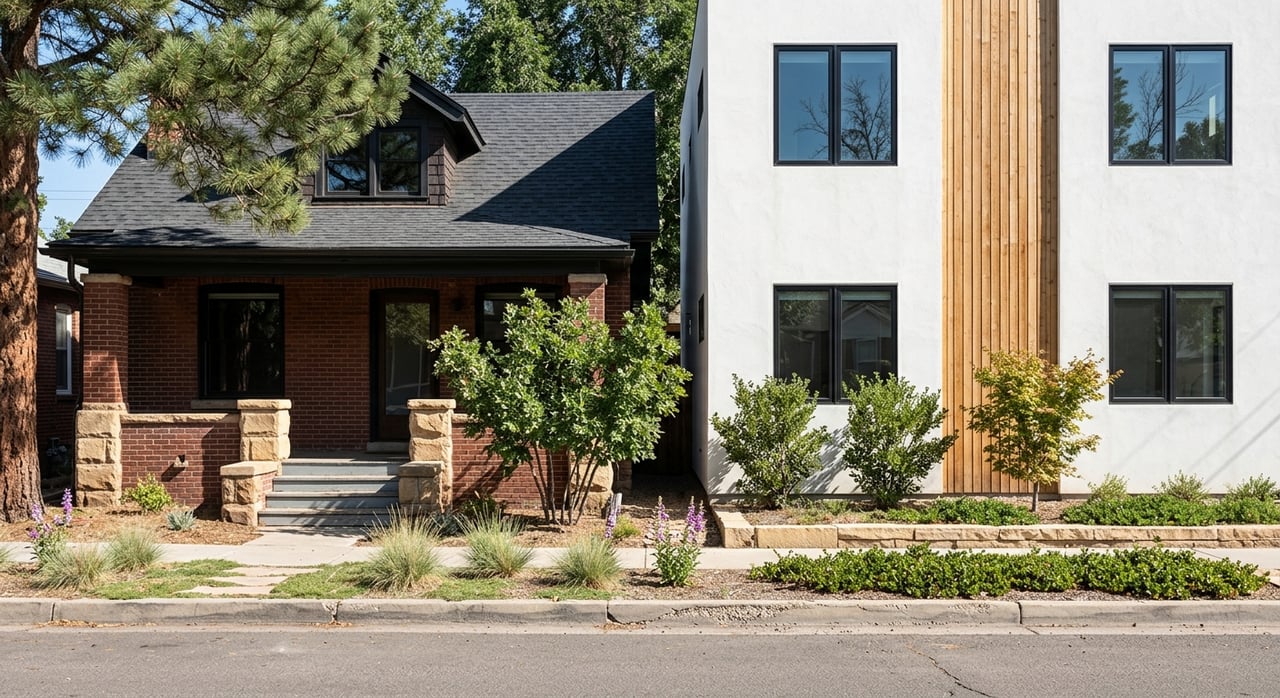
Whittier vs Nearby Boulder Neighborhoods: Key Differences
If you are deciding between Whittier and a few of Boulder’s best-known central neighborhoods, the differences can feel subtle at first and very important once you look closer. You may be weighing walkability, architecture, remodel potential, or simply which area fits the way you want to live day to day. This guide breaks down how Whittier compares with Mapleton Hill, Newlands, and Downtown Boulder so you can narrow your search with more confidence. Let’s dive in.
Whittier is one of Boulder’s earliest residential neighborhoods, located just east of downtown. That gives it a central location with a true neighborhood feel, rather than the more commercial energy you find in the downtown core.
Historically, Whittier developed as an older residential district with many homes built on more modest lots near the creek and railroad tracks. Today, that history still shows up in its scale, character, and street-level feel.
A key difference is regulation. Whittier is not one of Boulder’s 10 locally designated historic districts, which can matter if you are thinking about remodeling, adding on, or making exterior changes.
Mapleton Hill has the strongest historic-district identity in this comparison. The city identifies it as Boulder’s third and largest historic district, and about 57% of its roughly 500 homes were built before 1910.
That gives Mapleton Hill a more curated, preservation-oriented feel than Whittier. If you are drawn to classic architecture and a stronger sense of historic continuity, Mapleton Hill is often the clearest fit.
Whittier, by contrast, feels more flexible. It still has historic character, but without the same district-level preservation framework.
Whittier offers a broad mix of large Victorians, farmhouses, cozy bungalows, condos, and townhomes. That variety can appeal to buyers who want character but also want more options in housing type.
Mapleton Hill is known for a deeper concentration of classic architectural styles, including Queen Anne, Gothic Revival, Shingle, Colonial Revival, Foursquare, and Neoclassical homes. It tends to feel more uniformly historic from block to block.
For buyers who care about design, this is one of the biggest differences. Whittier often feels like character plus flexibility, while Mapleton Hill feels like historic prestige plus preservation structure.
Whittier has a Walk Score of 86, ranking as Boulder’s third most walkable neighborhood. Mapleton Hill is close behind at 83, ranked fourth.
In practical terms, both neighborhoods support a walkable lifestyle. The difference is that Whittier is often a little more connected to everyday downtown errands and destinations, while Mapleton Hill tends to trade some of that convenience for quieter, more consistently historic residential blocks.
Current listing snapshots show a major price gap. Whittier’s median listing price is $975,000, while Mapleton Hill’s is $2,725,000.
That does not mean every home will fit neatly into those numbers, but it does highlight market positioning. For many buyers, Whittier is the more accessible way into central Boulder living.
Newlands has a different rhythm than Whittier. It is described as an established residential neighborhood shaped largely in the 1920s through the 1940s, with cottages and bungalows alongside larger, more expensive homes.
Compared with Whittier, Newlands often feels quieter and more spacious. If you want a more residential setting and do not mind being a bit less connected on foot to downtown destinations, Newlands may feel like a better match.
This is one of the clearest contrasts in the group. Whittier’s Walk Score is 86, while Newlands comes in at 57.
Boulder overall is a walk-friendly city, but Whittier benefits much more directly from its central location. Newlands can still work well for biking and local errands, yet it leans more toward a residential lifestyle than a walk-everywhere lifestyle.
Newlands is also in a very different pricing tier. The current median listing price is $3,072,500, compared with $975,000 in Whittier.
For buyers comparing the two, this usually comes down to priorities. Whittier tends to offer centrality and relative price accessibility, while Newlands tends to offer a more premium residential setting.
Whittier has a distinct practical advantage for buyers who want an elementary campus physically inside the neighborhood. Whittier International Elementary is located at 2008 Pine Street, and the school notes that it is the only public school in Boulder offering the International Baccalaureate Primary Years Programme.
In Newlands, Foothill Elementary is closely associated with the area, though exact attendance should always be verified by address through BVSD’s School Finder. That address-by-address step matters in all of these neighborhoods, especially near boundary edges.
Whittier and Downtown are close neighbors, but they live differently. Whittier is the historic residential fringe, while Downtown Boulder is the city’s historic civic and commercial core.
Downtown has the most mixed-use feel of the four neighborhoods in this comparison. If you want to be closest to shops, restaurants, and the energy of central Boulder, Downtown usually delivers the strongest urban experience.
Whittier can offer a middle ground. You stay very close to downtown destinations while living in a more residential block pattern.
Both neighborhoods are highly walkable. Whittier has a Walk Score of 86, and Downtown Boulder scores 84 at the neighborhood level, with some core locations scoring much higher.
In real life, Downtown may feel more convenient for immediate access to Pearl Street and daily commercial destinations. Whittier often feels better if you want those benefits without living in the most urban part of the city.
Downtown is the most commercial and mixed-use area in the group, with more condo- and urban-oriented housing patterns. Whittier remains more residential in character, even though it also includes condos and townhomes.
Current listing data places Downtown Boulder at a median listing price of $898,600, slightly below Whittier’s $975,000. That makes both neighborhoods more accessible than Mapleton Hill and Newlands in the current snapshot.
Downtown’s school access profile is different from Whittier’s. Boulder High School is downtown, and Casey Middle School is also centrally located, so central Boulder offers strong access to secondary schools.
Downtown is not best described as an elementary-campus neighborhood. Whittier stands out more clearly for buyers who want an elementary school embedded in the neighborhood itself.
Whittier is a strong fit if you want a central Boulder address, excellent walkability, and a neighborhood that still feels residential. It also stands out if you want more pricing accessibility than Mapleton Hill or Newlands.
For remodel-minded buyers, Whittier may deserve extra attention. Because it is not a locally designated historic district like Mapleton Hill or Downtown, you should not assume the same district-level preservation review applies.
That difference can matter if you are evaluating an addition, exterior updates, or a more ambitious redesign. This is where local guidance and construction literacy become especially useful.
Mapleton Hill is often the best fit if your top priority is classic Boulder architecture and a highly historic setting. It offers a more preservation-minded identity and a stronger concentration of older homes.
The tradeoff is typically cost and less flexibility. Buyers who love the setting often accept both.
Newlands often fits buyers who want a quieter, more established residential feel and are comfortable giving up some walkability. It can feel more spacious and more removed from downtown activity.
The tradeoff is price and convenience on foot. For the right buyer, that quieter rhythm is the whole point.
Downtown Boulder is the clear choice if you want the most urban lifestyle in this group. It puts you closest to Pearl Street, commercial activity, and a more mixed-use environment.
The tradeoff is that it feels less like a pure residential neighborhood. If you want walkability first and a neighborhood feel second, Downtown may be the better fit.
If you are touring central Boulder, it helps to compare these areas through four simple lenses:
In many cases, Whittier becomes the shortlist neighborhood because it balances these factors better than people expect. It offers centrality, character, and flexibility in a way that is distinct within Boulder.
If you want help comparing Whittier with Mapleton Hill, Newlands, or Downtown at the block-by-block level, John Canova can help you evaluate not just location, but also architectural character, remodel potential, and long-term fit.

Team up with John to ensure your next Boulder Real Estate Transaction is a Success.