Architectural Styles That Define Mapleton Hill Homes
If you picture Mapleton Hill as a neighborhood of grand old Victorians, you are only seeing part of the story. This historic Boulder district has a strong visual identity, but its character comes from a deeper mix of architecture, landscape, and carefully managed change over time. If you are buying, selling, or simply trying to understand what makes Mapleton Hill feel so distinct, this guide will help you read the neighborhood with a sharper eye. Let’s dive in.
Mapleton Hill is Boulder’s third and largest historic district. The city designated it in 1982 and expanded it in 2002, and the district is generally bounded by Concord Street to the north, Spruce Street to the south, 4th Street to the west, and Broadway to the east.
City materials describe roughly 500 homes in the district, with nearly 57% built before 1910. The district’s period of significance runs from 1865 through 1946, which helps explain why the neighborhood feels layered rather than tied to one single era.
That distinction matters if you are looking at homes here. Mapleton Hill is not defined by one architecture style alone, but by how many styles fit into a coherent historic streetscape.
For many people, the image of Mapleton Hill starts with late-Victorian houses, especially Queen Anne homes. These are often the most visually memorable properties in the district and the easiest to identify from the street.
Boulder’s design guidelines describe Queen Anne as one of the most ornate Victorian styles in Colorado. Common features include asymmetrical massing, corner towers or bays, decorative porches, projecting gables, contrasting materials, and elaborate trim.
A local example at 1039 Mapleton Avenue shows many of those traits, including a tower, stained glass, carved trim, varied materials, and bay and dormer elements. When buyers talk about the “storybook” feel of old Boulder, this is often the architecture they are responding to.
These houses tend to have strong vertical proportions and layered exterior detail. You may also see shingled gables, ornamental woodwork, and a more expressive facade than you would in later homes.
From a design standpoint, Queen Anne houses often appeal to buyers who want visible craftsmanship and a clear sense of history. They are rarely understated, which is exactly part of their draw.
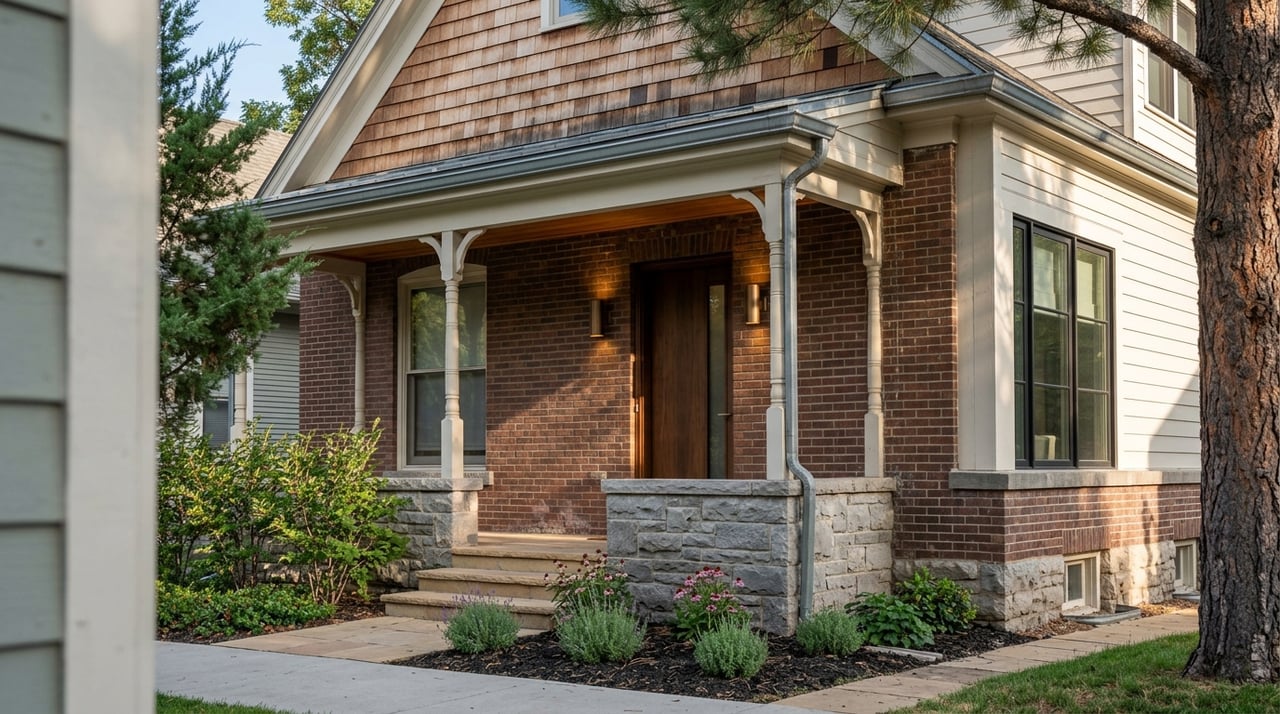
Mapleton Hill is not all towers, trim, and decorative flourishes. The neighborhood also includes Craftsman and bungalow-related homes that offer a more grounded, restrained expression of historic design.
Boulder’s historic design guidelines describe these homes as typically modest one- to one-and-a-half-story buildings with large covered porches, low overhanging roof forms, and squared or tapered porch columns, often set on pedestals. The style shifts attention from ornament to structure, materials, and livability.
One example is 2409 5th Street, identified as a Craftsman house with early Craftsman influences. City records describe stone and half-timbered exterior materials, overhanging eaves, brackets, heavy porch piers, and corbelled chimneys.
If Queen Anne reads as expressive and decorative, Craftsman tends to feel warmer and more substantial. The lines are cleaner, the materials feel heavier, and the porches often play a larger role in how the home meets the street.
For buyers, this can translate into a different kind of historic appeal. You still get age and character, but with a calmer architectural language.
One of the most important things to understand about Mapleton Hill is that it is broader than a Victorian-only narrative. Local inventory records show Tudor Revival examples at 535 Mapleton Avenue and 604 Mapleton Avenue, along with a Colonial Revival example at 1020 Mapleton Avenue.
These homes expand the visual palette of the neighborhood. Instead of one dominant style repeated over and over, Mapleton Hill presents a collection of early 20th-century forms that work together within the same district.
The Mapleton Hill School at 840 Mapleton Avenue adds another important layer. The city describes it as a Richardsonian Romanesque building from 1888 and the first building on Mapleton Avenue, which reinforces how varied the district’s architectural record really is.
If you are shopping for a home in Mapleton Hill, you are not limited to one aesthetic. You may find ornate Victorian detailing, a more formal Colonial Revival look, or the distinct lines of Tudor Revival, all within the same historic framework.
That range is part of the neighborhood’s appeal. It gives design-minded buyers more options while still preserving a strong sense of place.
With so many architectural styles present, you might wonder why the neighborhood still feels unified. The answer is that Mapleton Hill’s character comes from more than individual facades.
Boulder notes that a historic district includes not only buildings, but also sidewalks, tree canopy, building pattern, and the spaces between buildings. In Mapleton Hill, mature trees, the bluff setting, porches, massing, and the rhythm of homes along the street all contribute to the neighborhood’s identity.
Rear accessory structures also matter. The district overview notes that barns, sheds, chicken coops, carriage houses, and garages typically sit at the rear of lots and help communicate the district’s historic character.
This is one reason Mapleton Hill feels so visually consistent even when one home is Queen Anne and the next is Craftsman or Tudor Revival. The cohesion comes from scale, spacing, landscape, and the overall street rhythm as much as from style.
That is useful context whether you are evaluating value, planning a remodel, or deciding how a particular property fits into the larger block.
Mapleton Hill’s story does not end in the 1910s. The city’s period of significance extends through 1946, and records include 28 homes constructed between 1931 and 1947.
In many cases, the neighborhood’s later history shows up not as wholesale replacement, but as updates, additions, and accessory structures. The Queen Anne house at 1039 Mapleton Avenue, for example, includes a 1946 garage, which is a small but telling reminder that these homes evolved with changing needs.
This matters if you are looking at a property with later modifications. In Mapleton Hill, those changes are often part of the neighborhood’s layered history rather than evidence that a home has somehow stepped outside it.
A common misconception is that historic districts are frozen in time. Boulder explicitly says that historic designation does not freeze a place in time. Instead, it protects historic, architectural, and environmental character while guiding how change happens.
For property owners, that has real implications. All exterior changes to a designated property or to a property within a historic district require review and approval through a Landmark Alteration Certificate.
If you are considering a purchase in Mapleton Hill, this is an important part of due diligence. Exterior updates, additions, and even accessory structures may involve a review process, so understanding the rules early can help you avoid surprises.
District-specific guidance makes clear that new construction does not have to imitate historic architecture. Instead, it should fit the district’s character by reflecting elements such as massing, rooflines, windows, porches, and front entries while remaining differentiated from older work.
The city also notes that new buildings at the rear of a lot should be smaller, less massive, and more simply detailed. New accessory buildings should follow the district’s historic pattern of small, utilitarian outbuildings.
For post-1940 structures, major exterior renovation should respect the existing building as much as possible. The guidelines generally discourage adding a full or partial story, and they indicate that rear additions are usually more appropriate than increasing the building’s height.
If you are buying in Mapleton Hill, architecture is not just about looks. It affects how you evaluate renovation potential, future approvals, and how a property fits into the district’s long-term character.
If you are selling, understanding the style and historical context of your home can help shape stronger positioning. A Queen Anne home, a Craftsman house, or a later contributing structure may each appeal to buyers for different reasons, and those differences deserve a thoughtful strategy.
This is where local knowledge and construction literacy can be especially valuable. In a neighborhood like Mapleton Hill, the best decisions often come from understanding both design significance and the practical realities of what can be changed.
If you want help evaluating a Mapleton Hill property, positioning a historically significant home for sale, or thinking through renovation potential with clear local context, John Canova is a trusted resource for design-minded Boulder buyers and sellers.

Team up with John to ensure your next Boulder Real Estate Transaction is a Success.