When Does North Boulder Park Turn Into a Ski Track? The Snow Math Behind Newlands' Winter Loop
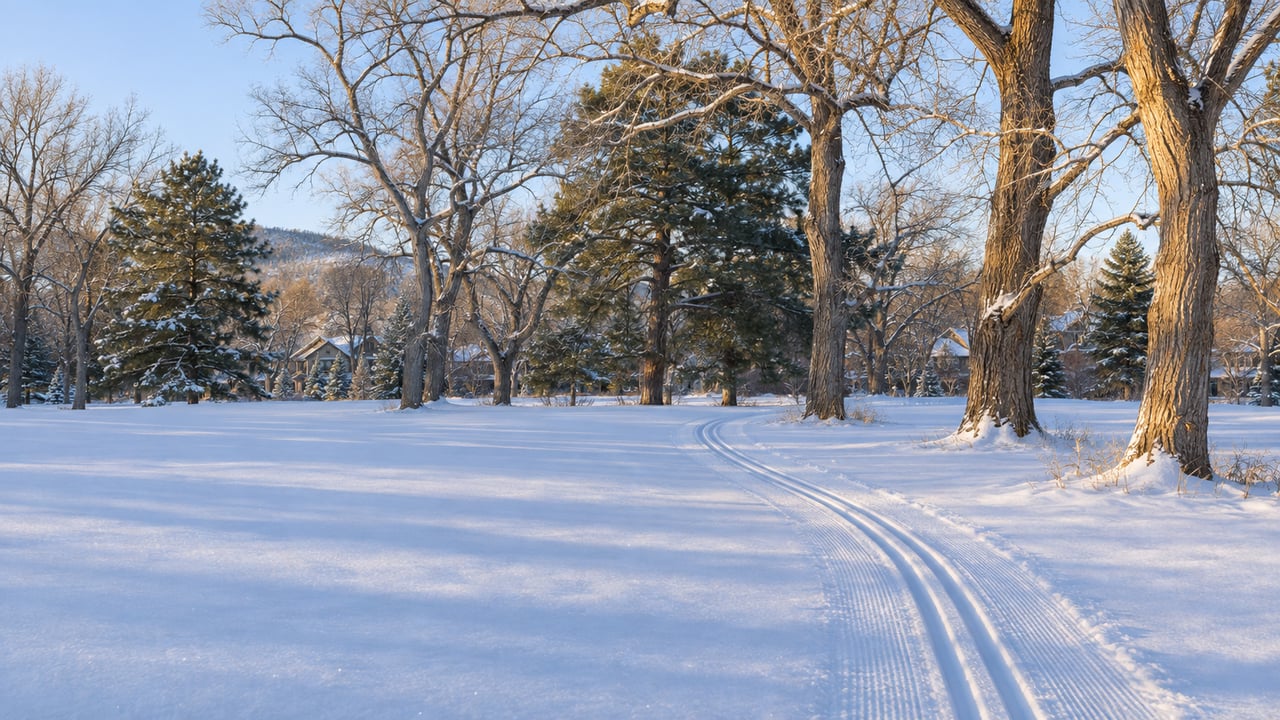
After a real storm, the big lawn between Dellwood and Balsam stops being a place for volleyball and picnic blankets. By morning there are two parallel grooves running in a loop around the park. They were laid in the dark by a volunteer on a snowmobile. You can ski them with the Flatirons in view, a few blocks from your front door. Then, often within a week, the grass starts showing through.
That short stretch is the whole Nordic season at North Boulder Park. The track is real, it's maintained, and the city is designing around it. But it runs on a specific snow-depth threshold, and Boulder doesn't reach it often. Last winter it reached it only a handful of times.
The Boulder Nordic Club has groomed the park under an agreement with the city since 1991. Member dues paid for the snowmobile and grooming equipment, according to a 2012 Daily Camera profile of the volunteer crew. The same piece describes the setup. A utility snowmobile tows a grooming implement that presses the air out of the snow, and then the ski tracks are set.
The useful part for anyone watching a storm roll in from a Newlands window is the minimum depth. Matt Muir, the crew's volunteer head groomer at the time, gave the Daily Camera his rule of thumb:
"If you get real light, powdery, dusty, ash-like snow, I need 5 to 6 inches, at least. If you get an autumn or spring snow that's denser, you can go on as little as 3 inches."
By that rule, the cold, fluffy January storms that look most like ski weather need about twice the depth of a heavy, wet spring dump. So a slushy March storm can make for a better ski morning at the park than a pretty midwinter dusting.
The loops themselves are short. Nordic Pulse, where the club posts grooming reports, lists an Inner Loop of 0.86 kilometers and an Outside Loop of 0.84 kilometers. Together that's about 1.7 kilometers, or just over a mile, for a lap of both. It works for a lunch-hour ski or for a kid's first time on skinny skis.
The club's end-of-season note on Nordic Pulse, posted April 15, 2026, sums up the 2025–26 winter: "Despite getting the least snowfall in a season since 1982, we groomed 6 times at North Boulder Park for 8+ skiable days, depending how much grass you tolerate."
NOAA's Physical Sciences Laboratory keeps an official Boulder monthly snowfall record, and it shows how lean that winter was. The September 2025 through June 2026 snow year came in at 41.4 inches. The 1991–2020 average is 89.71 inches. The prime skiing months show it most clearly:
| Month | 2025–26 snowfall | 1991–2020 average |
|---|---|---|
| November 2025 | 0.3 in | 12.69 in |
| December 2025 | 12.0 in | 12.33 in |
| January 2026 | 10.7 in | 11.76 in |
| February 2026 | 0.0 in | 14.78 in |
| March 2026 | 5.4 in | 14.59 in |
| April 2026 | 1.7 in | 13.59 in |
| May 2026 | 11.3 in | 1.99 in |
December and January came close to normal, and that's likely where most of those six grooms came from. February had no snow at all in a month that normally brings almost 15 inches. Then May brought more than five times its usual snowfall, at a point when the park's lawn was already greening up.
So for the Inner and Outside loops, a winter is a string of separate storms, each of which either clears Muir's threshold or doesn't. A monthly total doesn't capture that. Sunny Front Range days melt snow between storms, so a 12-inch month can still produce only a few skiable mornings.
Through October 2026, the same NOAA record shows 0.0 inches of snow in Boulder for both September and October. September averages 1.03 inches, October averages 6.95, and November averages 12.69. That puts the season about eight inches behind the long-term pace before the usual first storms of the season had a chance to arrive.
NOAA's U.S. Winter Outlook, released October 15, 2026, is built around El Niño. For December 2026 through February 2027, it favors warmer-than-average temperatures across the northern U.S. and lists the northern Rockies among the areas with the best odds of a warm winter. In NOAA's description, a very strong El Niño tends to push the jet stream south and east and favors stormier weather across the South.
None of that rules out a big upslope storm over the park. It does mean each ski window is likely to be short, as it was last year, and the people who catch one are the ones who already know how to find out the track is set.
Catching one is mostly a matter of setting things up before the storm arrives.
The short loops have one practical upside. When a groomed morning comes on a workday, a few laps before work fit into the time most people would spend shoveling.
This loop matters more than eight ski days a year would suggest, and the evidence is in the city's renovation plan for North Boulder Park.
During public engagement, residents pushed to keep the park's open, flexible character. The city's project page names "expansive green space, Nordic skiing, and self-organized community activities" as core to the park's identity. The Final Concept Plan, presented to the Parks and Recreation Advisory Board on March 23, 2026, adds a Nordic ski overlay to show that skiing can continue. Walkways near the play area were moved mostly back to where they are now, partly to leave room for more variation in the ski track.
The city's common questions page goes into more detail. The project team went out with the Boulder Nordic Club for the first grooming of last season. They measured the snowmobile's turning radius and skied laps. The plan keeps an inner and an outer loop at almost the same lengths as today's, and it keeps the northeast "hill" and the southwest tree skiing. The ballfields used by North Boulder Little League shift 70 feet south of where they are now. An earlier version had moved them 510 feet. A teen space, developed with input gathered through Growing Up Boulder, sits north of the existing fitness area, where it doesn't affect the ski track.
The schedule matters for this winter. The city's timeline puts the restroom and pavilion renovation between October 2026 and March 2027, with site permitting running through December 2026. Construction on the wider site is set to begin in September 2027. When finished, the pavilion will open east toward the playground and south onto a lawn facing the Flatirons. Site construction is scheduled to start after this winter, so this season's skiing happens on the park's current layout.
Questions about how a park like this one shapes daily life on the streets around it, or what a Newlands home within a few blocks of the track has to offer, are the kind of local detail John Canova works through with clients every season. If you'd like to talk it over, reach out and Work With John.

Team up with John to ensure your next Boulder Real Estate Transaction is a Success.